
Islam is based on five ‘pillars’. They are as follows:
1. Shahadah
This is to firmly believe in your heart and declare:

Ashhadu allaa ilaaha illallaahu, wa ashhadu anna Muhammadar Rasulullaah.
“I bear witness that there is no God except Allah and I bear witness that Muhammad is Allah’s Messenger.”
This is the Shahadah and it is the very basis of Islam. It is all a person need declare to become a Muslim. The Shahadah has two parts. The first part is a declaration that Allah is the only Lord and Ruler and He Alone is worthy of worship. He has no partner and He cannot be compared with any other thing. Everything which is in this universe is under His Control and works according to His Command. Mankind is also required to live according to the Commands of Allah. Allah loves those who follow His Command. Allah dislikes those who disobey Him.
The second part of the Shahadah is the declaration that Muhammad (Allah’s Peace and Blessings be upon him) is the Messenger of Allah. He was the one who brought the Qur’an to us. Muslims are required to obey the Prophet (Allah’s Peace and Blessings be upon him) and follow his exampole without any hesitation.
Muslims are required to honour and respect him and ask Allah to give him blessins and salutations. Whenever his name is mentioned we must say:
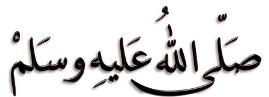
Sallallaahu alayhi wa sallam
Allah’s Peace and Blessings be upon him.
2. Prayer
This is to pray (perform Salaat) five times a day. It is one of the distinguishing features of Islam. A person only abandons the prayer at the risk of going out of Islam.

Verily the prayer is enjoined on the believers at fixed hours. [an-Nisa 4:103]
Prayer is the most essential obligatory duty which a Muslim must perform. This is the most obvious act which a Muslim does to show his obedience to Allah. Prayer is also a means of remembering Allah.
In prayer, a person leaves everything behing and devotes themselves to the worship of Allah. He prays as he has been instructed by Allah’s Messenger (Allah’s Peace and Blessings be upon him). They change from one posture to another in a composed manner, focusing their mind on Allah. They feel that they are standing before Allah the Almighty. Prayer is a means of bringing mankind closer to Allah. In prayer, one stands facing the direction of the Ka’bah (in Makkah, Saudi Arabia) and bows and kneels before their Lord. They recite the opening chapter of the Qur’an (Surah al-Fatihah) praising and glorifying Allah and then asking for His Support and Help.
This is Surah Al-Fatihah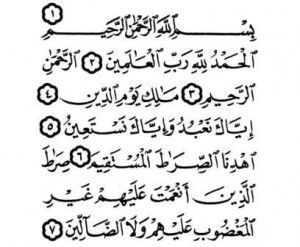
In the name of Allah, the Beneficent, The Merciful (1)
Praise be to Allah, the Cherisher and Sustainer of the Worlds (2)
Most Gracious, Most Merciful (3)
Master of the Day of Judgement (4)
Guide us upon the straight way (6)You alone do we worship and you help alone do we seek (5)
The way of those on whom You have bestowed Your Grace, Not the way of those who have earned Your Anger or gone astray. (7)
Due to its importance, every Muslim, male and female, must learn how to perform the prayer. Children should start performing it at the age of seven, and it is obligatory for them to pray from the age of ten. Prayer must be done by all Muslims and in all conditions. Those cannot stand, can pray sitting down. Those who cannot sit, can do it lying down.
There are five prayers to be observed every day, within their alloted times. They are:
1. Fajr – which starts at dawn and is to be prayed before the sun rises.
2. Zuhr – which is to prayed at noon when the sun begins to decline from the meridian.
3. ‘Asr – which is prayed in the late afternoon.
4. Maghrib – which is prayed when the sun sets.
5. ‘Isha – which is to be prayed at night, before going to bed.
As you can see, the Muslim’s day starts and ends with prayer. Prayer may be performed individually or in congregation. The person who leads the prayer is called the Imam and he stands in front of the congregation and the congregation follows him through each step of the prayer.
On Fridays there is a special prayer for which it is compulsory for men to attend and women may also attend if they like. This prayer is performed in place of the Zuhr prayer on Friday. Before the prayer the Imam gives a khutbah (sermon) which usually contains advice or guidance for Muslims on how to deal with the problems of daily life.
Before performing the prayer a person needs to make sure that their clothes, body and the place of worship are clean. A special act of cleaning called wudu’ (ablution) must be done before the prayer. To perform the wudu‘ the person first washes their hands, then rinses the mouth and nose. Then they wash their faces and then their arms up to the elbows. After that, wet hands are wiped over the head, they clean their ears and finally the feet are washed, up to the ankles. Each time you perform wudu‘ then you should wash all those indicated parts three time, except for wiping the head and cleaning the ears which is only done once.
3. Zakat
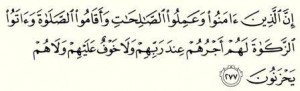
“Truly, those who believe and do good deeds of righteousness
and perform the prayer and give Zakat, they will have their reward with
their Lord. On the shall be no fear and they shall not grieve.”
[Al-Baqarah 2:177]
Zakat is an annual payment made by people. It is not a tax imposed by Islam, but a due fixed by Allah so that the wealth of a person may be purified.
Zakat is also to remind a person that his wealth is not his own, but its real owner is Allah. This should make a person ready to spend it in accordance with Allah’s Commands. Zakat becomes due on savings which have been kept for one full year. Two and half percent of the total money is given to those who are in need. For example, if a person has £1,000 in saving which they have kept for a year then he will have to pay £25.
Zakat is an act of worship. It is also a way of showing sympathy to those who are less fortunate. It is meant to take away from our hearts gree and the love of money. It is also to bridge the gap between rich and poor.
4. Fasting
Fasting means to keep away from eating, drinking and sexual relationships between a married couple between dawn and sunset. It is compulsory for every Muslim during the month of Ramadhan.
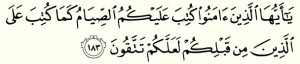
“O you who believe, fasting is prescribed for you as it
was prescribed for those before you, that you may attain piety.”
[Al-Baqarah 2:183]
Fasting is both a spiritual and physical exercise. The person who is fasting is required to keep themself away from any act which displeases Allah. They should not engage in any evil behaviour. Fasting throughout Ramadhan trains one to control the desires and teaches one self-discipline. Fasting also helps to strengthen the willpower, endurance and steadfastness.
Fasting provides Muslims with the opportunity to experience hunger and thirst suffered by many starving people in the world. A Muslim can learn and understand what it really feels like not to have the food or drink. A Muslim will then be able to show sympathy and be more prepared to help and support them.
Fasting is the true manifestation of obedience to Allah as the person who fasts does for the sake of Allah who has prepared a great reward for those who fast.
During Ramadhan a special prayer called Tarawih is performed in which parts of the Noble Qur’an are recited so that the whole book is read by the end of the month. The month of Ramadhan is also important as it contains a special night called Laylay-ul-Qadr which was the night that the Noble Qur’an was first revealed. It is a night full of blessing. Any worship done during the night of Laylat-ul-Qadr carries the reward of more than one thousand months. We are not told when exactly in Ramadhan that the night of Laylat-ul-Qadr occurs , only that it is one of the odd-numbered nights in the last ten days of Ramadhan.
At the end of Ramadhan, Muslims cease their daily fasts and celebrate on the day called Eid-ul-Fitr. This is a day of rejoicing for successful completion of Ramadhan and a month of fasting. It is a happy occasion when Muslim families get together. The day of Eid-ul-Fitr starts with a special prayer. Before going to the masjid (mosque) all Muslims are required to pay Sadaqat-ul-Fitr for themselves and their dependents. This money goes to the poor and needy so that can join in the celebrations on the day.
5. The Hajj
The fifth pillar of Islam is to perform Hajj (pilgramage) to Makkah. It is compulsory on Muslims who can afford the expense and are physically able, to undertake the journey. It is an obligation to do the Hajj at least once in a lifetime. Hajj is the largest annual gathering of Muslims and they come from all over the world to assemble in Makkah. Hajj is a good demonstration of the fact that Islam has spread so far and that it is a universal religion and everyone is equal to each other.
Pilgrims wear the same clothing and gather on the plains of Arafat. This is another reminder that one day all people will be gathered on the Day of Judgement when all will be judged by Allah. Hajj is a symbol of devotion to Allah and obedience of His Commands.