Outward Actions & Inward Beliefs
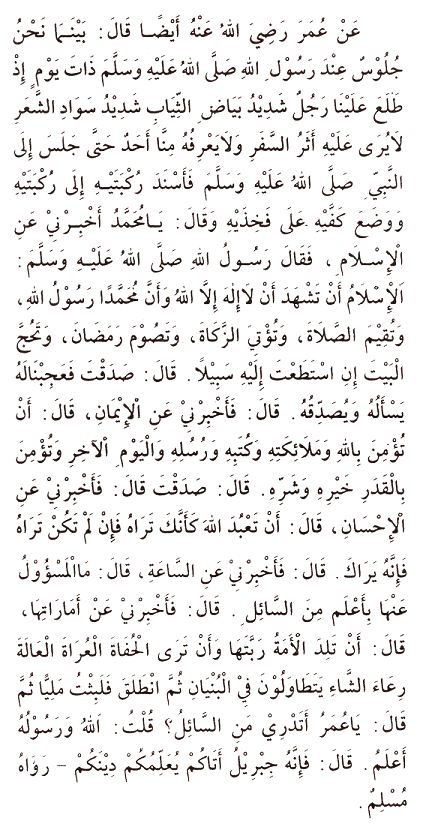
Jibreel (as) turns to the Prophet (sas) and says, “Tell me about Islam”. The Prophet’s answer was centered around outward actions. Then he asks him about iman and the Prophet’s answer focused on internal actions of belief and of thought.
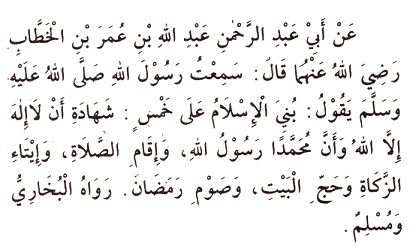
Islam and iman are interchangeable concepts revolved around the five pillars of action and the six foundations of belief. When Islam and iman are mentioned together in the same place, then Islam refers to the outward actions and iman refers to the inward beliefs.
Belief manifests itself. The scholars say that a belief lives in the heart and shows itself on the actions and on the tongue. For example, the Prophet (sas) said that the Muslim is the person who the people are safe from his hands and his tongue. And the believer is the one who people trust him with their wealth and themselves.
The Big Three: Islam, Iman, & Ihsan
Scholars consider Islam, Iman and Ihsan the three stages in the path towards Allah (swt). The first path is you force yourself and bring yourself to do those actions which you know that Allah wants you to do. The second level is iman where you are not only doing those actions, but you are strengthening your relationship with Allah (swt) and you’re beginning to taste the sweetness of your relationship with Allah. The third level is the level of Ihsan, which is to worship Allah as if you see Him, and even if you cannot see Him, to know that He sees you. So, you are moving in this path, this journey, towards the Divine. And in doing so, it’s getting more and more intense.
The Hour
When Jibreel asked the Prophet (sas) about the hour, He said, “The one who is being asked about it is not more knowledgeable about it than the one who is asking.” Here, the Prophet (sas) is saying, this is something that Allah (swt) keeps to Himself and it is part of the “ghayb” (unseen). This is an important lesson because it doesn’t matter when the Day of Judgment is, what really matters is what and how we are preparing for it. We should be continuously striving to please Allah and seek his forgiveness.
The Signs
The next question was, “So, tell me about it’s signs, tell me about the things that will occur”. These signs are considered as warnings. The Prophet (sas) gave two signs to this particular hadith of the end of time. One of them is, “the slave woman will give birth to her master,” and the tense is feminine so it is referring to her female master.
One of the interpretations that relates to modern time would be: The one who gives birth is supposed to be in power, or have some sort of level or authority over the one who she gives birth to. But this here is a flipping of the scale. The one who gives birth becomes the servant of the one who is born. Whereas before, the child would respect, honor and listen to their parents. Now it’s the complete opposite, and if you look around, you will see it. You see and feel as if the parents are slaves to the children. Parents desperately trying to please their children, and moms are trying to imitate their daughters.
The second sign; is the person will see barefooted, lightly dressed, and poor people who are shepherds. They will see these people competing with one another in their buildings. The point here is you have these people who don’t have anything, they are very poor. Then suddenly the situation changes for them, and they are competing with one another over who can build the tallest building. They are competing to see who has the nicest car, the latest gadgets, etc.
Bounty of Allah
In the end, all of this is from the blessings of Allah (swt). Allah (swt) gives us so much and rather than being humble and grateful in front of Allah, we are arrogant and think that it is all from us. Righteousness, putting full effort and trying one’s best will all eventually lead to success and wealth. But at the end of the day, we still have to acknowledge that no matter how much effort we put in, our wealth and success will always be in the hands and bounty of Allah. So, being successful and having wealth should give us more reasons to increase our humility and increase our gratitude towards our Lord.