6
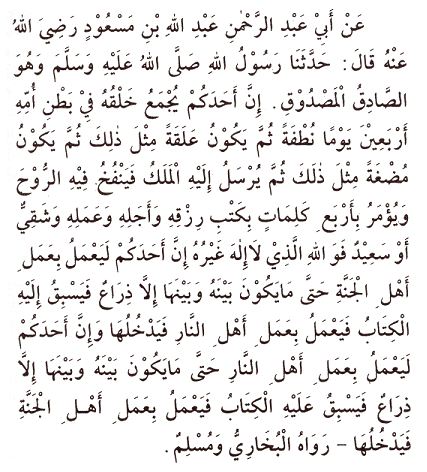
On the authority of Abdullah ibn Masud (may Allah be pleased with him), who said: The Messenger of Allah (peace be upon him), and he is the truthful and the believed, narrated to us:
Hadith 4 – Deeds are by their final actions
Hadith 4 - Deeds are by Their Final Actions
Verily the creation of each one of you is brought together in his mother’s womb for forty days in the form of a drop, then he becomes a clot of blood for a like period, then a morsel of flesh for a like period, then there is sent to him the angel who blows the breath of life into him and who is commanded with four matters: to write down his sustenance, his life span, his actions, and whether he will be happy or unhappy (whether or not he will enter Paradise).
By Allah, other than Whom there is no deity, verily one of you performs the actions of the people of Paradise until there is but an arm’s length between him and it, and that which has been written overtakes him, and so he acts with the actions of the people of the Hellfire and thus enters it; and verily one of you performs the actions of the people of the Hellfire, until there is but an arm’s length between him and it, and that which has been written overtakes him and so he acts with the actions of the people of Paradise and thus he enters it.
Bukhari and Muslim
This hadith is among many of the miracles in the life of the Prophet (sas). It gives unwavering credibility to the revelation of the words of Allah (swt): the Quran.
This hadith sums up the life of man from nothingness, showing the early relationship between the physical and the spiritual components of human existence, the encounter between a piece of flesh (mudgha) upon which the spirit (ruh) is breathed. Man must then navigate through a predetermined course of life (Al Qadaa wal Qadar), at constant risk of wavering in his actions, with significant consequences for him on his return to nothingness at death.
This hadith presents the physical and abstract components of man by its depiction of the embryonic stages of life and the explanation of predestination.
Proof for Truth
The narrator Abdullah ibn Mas’ud (ra) starts this hadith with a comment on the truthfulness of the Prophet (sas) as proof for the authenticity of the content of the narration. During the time of the Prophet (sas), the attribute of Al-Amin (the trustworthy one) was the reason for his followers’ belief in the message he was spreading. In recent times, the confirmation of the hadith’s contents and the Quranic texts on the same issue (Chapter 23 verse 14) as described by modern science should remove any doubt in anyone’s mind about the authenticity of the message of Islam and its messenger.
Being a visionary
The believers should be visionaries because they should always be checking their intentions and understanding the purpose of their actions. They should be persistently asking themselves about their intentions for their short term and their long goals. Overall, the believer should constantly ask himself; “Why am I doing what I am doing?”
Using the words “shall have” in this hadith means that the person will be rewarded for only that which he intended. So, as mentioned in the hadith, if a person performed the Hijrah, but did it with a different intention then he would not be rewarded for that action of Hijrah.
A Few Lessons
This hadith introduces the concept of fear and hope. Let fear overcome you in the matters of your good deeds as by Allah’s decree, one bad deed that follows may negate them. Conversely, let hope overcome you in the matters of your bad deeds as by Allah’s decree, one good deed that follows may purify you from their harm.
The concept of Al Qadaa Wal Qadar does not limit other hadith or negate Quranic texts that command the believer to continue to perfect his deeds hoping for the good in the hereafter. As described, this concept should help us understand the greatness of Allah, His limitless knowledge and our limits in comparison.
Finally, this hadith presents evidence that will help scholars in deriving fatwa on such complex issues of embryonic studies and other ethical issues such as abortion. The ultimate knowledge of all affairs is with Allah Alone, may He be glorified.