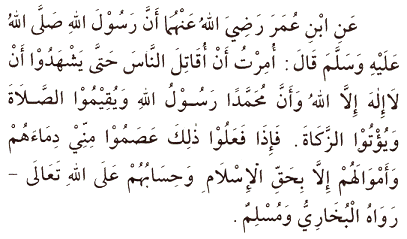
Abdullah bin Omar narrated that the messenger of Allah, sallallahu ‘alayhi wasallam, said:
“I have been ordered to fight against people until they testify that there is no god but Allah and that Muhammad is the messenger of Allah and until they perform the prayers and pay the zakat, and if they do so they will have gained protection from me for their lives and property, unless [they do acts that are punishable] in accordance with Islam, and their reckoning will be with Allah the Almighty.”
[Al-Bukhari and Muslim]
The majority of Scholars say that the “people” here refers to the Arab polytheists. The same interpretation can also be found in the Qur’an in Surah An-Nasr.
Another opinion say that the Prophet, sallallahu ‘alayhi wasallam, was referring to all people, excluding Ahlul Kitab, i.e. the people of the Book. It was said that this hadith was abrogated by the later rulings concerning jizziya (compensation).
A third opinion interprets the hadith as saying that people have to accept the domination or supremacy of Islam – that Islam is the dominant religion. This objective is to be achieved by whatever means, whether it is through fighting or through peaceful agreements.
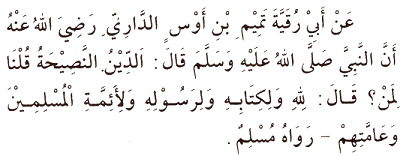
On the authority of Tamim Al-Dari that the Prophet, sallallahu ‘alayhi wasallam, said:
“Religion is nasihah.” We said: “To whom?” The Prophet, sallallahu ‘alayhi wasallam, said: “To Allah and His Book,
and His messenger, and to the leaders of the Muslims and their common folk.”
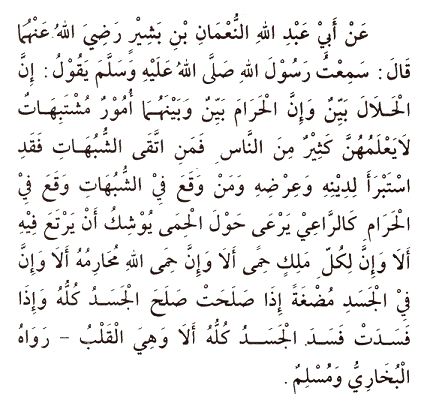
On the authority of Abu ‘Abdullah al-Nu’man bin Bashir, radiyallahu ‘anhu, who said: I heard the Messenger of Allah, sallallahu ‘alayhi wasallam, say:
“Truly, what is lawful is evident, and what is unlawful is evident, and in between the two are matters which are doubtful which many people do not know. He who guards against doubtful things keeps his religion and honour blameless, and he who indulges in doubtful things indulges in fact in unlawful things, just as a shepherd who pastures his flock round a preserve will soon pasture them in it. Beware, every king has a preserve, and the things Allah has declared unlawful are His preserves. Beware, in the body there is a flesh; if it is sound, the whole body is sound, and if it is corrupt, the whole body is corrupt, and behold, it is the heart.”
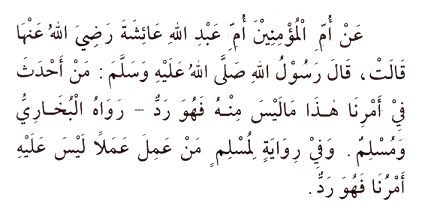
It is narrated on the authority of the Mother of the Believers, Umm ‘Abdullah ‘Aishah, radiyallahu ‘anha, that the Messenger of Allah, sallallahu ‘alayhi wasallam, said:
“Whosoever introduces into this affair of ours (i.e. into Islam) something that does not belong to it, it is to be rejected.”
[Al-Bukhari & Muslim]
According to the version in Muslim, (it reads): “Whosoever works a work which has for it no command of ours is to be rejected.”
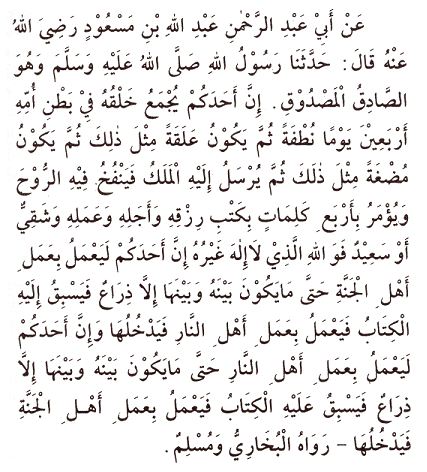
On the authority of Abdullah ibn Masud (may Allah be pleased with him), who said: The Messenger of Allah (peace be upon him), and he is the truthful and the believed, narrated to us:
Hadith 4 – Deeds are by their final actions
Hadith 4 - Deeds are by Their Final Actions
by Imam Nawawi | 40 Hadith
Verily the creation of each one of you is brought together in his mother’s womb for forty days in the form of a drop, then he becomes a clot of blood for a like period, then a morsel of flesh for a like period, then there is sent to him the angel who blows the breath of life into him and who is commanded with four matters: to write down his sustenance, his life span, his actions, and whether he will be happy or unhappy (whether or not he will enter Paradise).
By Allah, other than Whom there is no deity, verily one of you performs the actions of the people of Paradise until there is but an arm’s length between him and it, and that which has been written overtakes him, and so he acts with the actions of the people of the Hellfire and thus enters it; and verily one of you performs the actions of the people of the Hellfire, until there is but an arm’s length between him and it, and that which has been written overtakes him and so he acts with the actions of the people of Paradise and thus he enters it.
Bukhari and Muslim
This hadith is among many of the miracles in the life of the Prophet (sas). It gives unwavering credibility to the revelation of the words of Allah (swt): the Quran.
This hadith sums up the life of man from nothingness, showing the early relationship between the physical and the spiritual components of human existence, the encounter between a piece of flesh (mudgha) upon which the spirit (ruh) is breathed. Man must then navigate through a predetermined course of life (Al Qadaa wal Qadar), at constant risk of wavering in his actions, with significant consequences for him on his return to nothingness at death.
This hadith presents the physical and abstract components of man by its depiction of the embryonic stages of life and the explanation of predestination.
Proof for Truth
The narrator Abdullah ibn Mas’ud (ra) starts this hadith with a comment on the truthfulness of the Prophet (sas) as proof for the authenticity of the content of the narration. During the time of the Prophet (sas), the attribute of Al-Amin (the trustworthy one) was the reason for his followers’ belief in the message he was spreading. In recent times, the confirmation of the hadith’s contents and the Quranic texts on the same issue (Chapter 23 verse 14) as described by modern science should remove any doubt in anyone’s mind about the authenticity of the message of Islam and its messenger.
Being a visionary
The believers should be visionaries because they should always be checking their intentions and understanding the purpose of their actions. They should be persistently asking themselves about their intentions for their short term and their long goals. Overall, the believer should constantly ask himself; “Why am I doing what I am doing?”
Using the words “shall have” in this hadith means that the person will be rewarded for only that which he intended. So, as mentioned in the hadith, if a person performed the Hijrah, but did it with a different intention then he would not be rewarded for that action of Hijrah.
A Few Lessons
This hadith introduces the concept of fear and hope. Let fear overcome you in the matters of your good deeds as by Allah’s decree, one bad deed that follows may negate them. Conversely, let hope overcome you in the matters of your bad deeds as by Allah’s decree, one good deed that follows may purify you from their harm.
The concept of Al Qadaa Wal Qadar does not limit other hadith or negate Quranic texts that command the believer to continue to perfect his deeds hoping for the good in the hereafter. As described, this concept should help us understand the greatness of Allah, His limitless knowledge and our limits in comparison.
Finally, this hadith presents evidence that will help scholars in deriving fatwa on such complex issues of embryonic studies and other ethical issues such as abortion. The ultimate knowledge of all affairs is with Allah Alone, may He be glorified.
Al-Murshid al-Mu'een 7th June 2017 You can download an audio here - Lesson 4 Al-Murshid al-Mu’een – the Concise Guide to the Basics of the Deen – is a widely recognised primary text for learning Islam in North Africa. In it the author, Sidi Abd al-Wahid ibn ‘Ashir,...
Matn al-'Ashmawiyyah 27th June, 2017 Ghusl This is a course taught by Ustadh Abdus Shakur Brooks covering the entire text. This text covers the essentials of purification, prayer and fasting according to the Mālikī school. Matn al-'Ashmawiyyah. Purification -...
Matn al-'Ashmawiyyah 23rd June, 2017 Wudhu This is a course taught by Ustadh Abdus Shakur Brooks covering the entire text. This text covers the essentials of purification, prayer and fasting according to the Mālikī school. Matn al-'Ashmawiyyah. Purification -...
Mukhtasar al-Akhdari 22nd June 2017 You can download the audio here: Lesson 4 You can download a PDF translation here Mukhtasar Al-Akhdari was written by Abdur Rahman Al-Akhdari a famous Maliki scholar of the 10th century A.H. This text covers purification of the...
Al-Murshid al-Mu'een 7th June 2017 You can download an audio here - Lesson 3 Al-Murshid al-Mu’een – the Concise Guide to the Basics of the Deen – is a widely recognised primary text for learning Islam in North Africa. In it the author, Sidi Abd al-Wahid ibn ‘Ashir,...
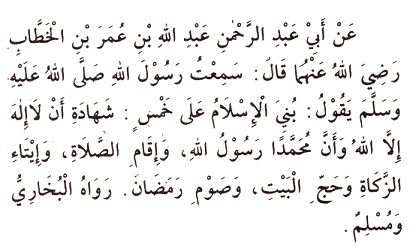
It is narrated on the authority of Amir al-Mu’minin (Leader of the Believers), Abu Hafs ‘Umar bin al-Khattab (may Allah be pleased with him), who said: I heard the Messenger of Allah (peace be upon him), say:
Hadith 3 – Islam is Built Upon Five
Hadith 3 - Islam is Built Upon Five
by Imam Nawawi | 40 Hadith
Islam has been built on five [pillars]: testifying that there is no God but Allah and that Muhammad is the Messenger of Allah, performing the prayers, paying the Zakah, making the pilgrimage to the House, and fasting in Ramadan.
Bukhari & Muslim
This hadith focuses on the five pillars of Islam. The Prophet (sas) describes the foundations of Islam as having been “built upon five.” These foundational actions are either of the tongue, heart or otherwise.
Imagine a home above the ocean, with five pillars that reach to the ground to support the home above. That is the imagery that comes to mind when the Prophet (sas) talks about these five aspects upon which Islam is built.
1. Shahadah: The Declaration of Faith
The Shahadah is a beautiful, profound, yet simple statement which brings one into Islam. All the person has to say is: “La ilaha illa Allah, Muhammad rasulAllah.” “I bear witness that there is no deity worthy of worship but God, and I bear witness that Muhammad is the Messenger of God.”
These few words in themselves are very powerful and sometimes we don’t realize that. We think about all the details in Islam, all of the sayings of the Prophet (pbuh), and many times we forget the Quran. Sometimes we become concerned about legal rulings and we forget that “La ilaha illa Allah Muhammad rasul Allah” is really the foundation of everything. It is an absolute commitment to worship nothing other than Allah and to put all of one’s reliance on Allah, and to follow the Prophet (pbuh) as His Messenger, who was sent to mankind to embody the divine message just as other Prophets before Him.
2. Establishing Prayer
The second pillar of Islam, after the declaration of faith, is the establishment of prayer. It is very interesting terminology that is used in “the establishment of prayer.” The verb used in Arabic implies effort. The verb is “to establish,” as if one is making something stand. Essentially you are making something stand, so you are making your prayer stand, you are making the prayer happen; you are pushing it to a curve, you are sticking with it, and you are leaning upon it. It is also a foundation for your relationship with Allah.
It is important that we make the effort and we put forth the proper means in order to pray our prayers on time. One of the easiest effort is to make the intention to always make the prayers at the beginning of their time.
3. Paying the Zakaah (Obligatory Charity)
The third pillar of Islam is foundational. Allah (swt) describes the believers in Surah Al-Mu’minun as those who observe and establish the institution of Zakaah in society:
“And they who are observant of Zakah.” (The Quran 23:4)
Allah has made it obligatory on the Muslims to pay a certain percentage , 2.5%, in Zakaah when their wealth exceeds a minimum amount and a year has passed since that amount has been accumulated. It could be gold, silver, or any sort of wealth.
4. Making Pilgrimage to the House of Allah (Hajj)
Hajj is to make pilgrimage to the house of Allah, the Kabah, in Mecca to perform the traditional rights that were performed by the Prophet (sas). Hajj is one of the most beautiful human experiences and one of the greatest migrations on earth. It is absolutely incredible to experience the unity of millions of Muslims making pilgrimage to the Kaaba from every corner of the world.
5. Fasting the Month of Ramadan
“Oh you who believe, fasting is prescribed upon you, as it was prescribed to those before you, that you may attain God-consciousness (taqwa)” (The Quran 2:183)
Al-Murshid al-Mu'een 7th June 2017 You can download an audio here - Lesson 4 Al-Murshid al-Mu’een – the Concise Guide to the Basics of the Deen – is a widely recognised primary text for learning Islam in North Africa. In it the author, Sidi Abd al-Wahid ibn ‘Ashir,...
Matn al-'Ashmawiyyah 27th June, 2017 Ghusl This is a course taught by Ustadh Abdus Shakur Brooks covering the entire text. This text covers the essentials of purification, prayer and fasting according to the Mālikī school. Matn al-'Ashmawiyyah. Purification -...
Matn al-'Ashmawiyyah 23rd June, 2017 Wudhu This is a course taught by Ustadh Abdus Shakur Brooks covering the entire text. This text covers the essentials of purification, prayer and fasting according to the Mālikī school. Matn al-'Ashmawiyyah. Purification -...
Mukhtasar al-Akhdari 22nd June 2017 You can download the audio here: Lesson 4 You can download a PDF translation here Mukhtasar Al-Akhdari was written by Abdur Rahman Al-Akhdari a famous Maliki scholar of the 10th century A.H. This text covers purification of the...
Al-Murshid al-Mu'een 7th June 2017 You can download an audio here - Lesson 3 Al-Murshid al-Mu’een – the Concise Guide to the Basics of the Deen – is a widely recognised primary text for learning Islam in North Africa. In it the author, Sidi Abd al-Wahid ibn ‘Ashir,...