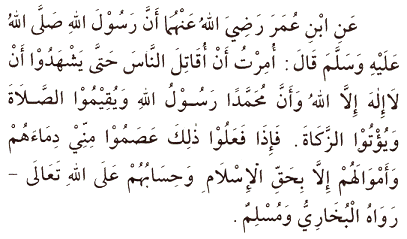
Abdullah bin Omar narrated that the messenger of Allah, sallallahu ‘alayhi wasallam, said:
“I have been ordered to fight against people until they testify that there is no god but Allah and that Muhammad is the messenger of Allah and until they perform the prayers and pay the zakat, and if they do so they will have gained protection from me for their lives and property, unless [they do acts that are punishable] in accordance with Islam, and their reckoning will be with Allah the Almighty.”
[Al-Bukhari and Muslim]
The majority of Scholars say that the “people” here refers to the Arab polytheists. The same interpretation can also be found in the Qur’an in Surah An-Nasr.
Another opinion say that the Prophet, sallallahu ‘alayhi wasallam, was referring to all people, excluding Ahlul Kitab, i.e. the people of the Book. It was said that this hadith was abrogated by the later rulings concerning jizziya (compensation).
A third opinion interprets the hadith as saying that people have to accept the domination or supremacy of Islam – that Islam is the dominant religion. This objective is to be achieved by whatever means, whether it is through fighting or through peaceful agreements.
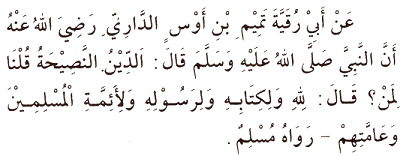
On the authority of Tamim Al-Dari that the Prophet, sallallahu ‘alayhi wasallam, said:
“Religion is nasihah.” We said: “To whom?” The Prophet, sallallahu ‘alayhi wasallam, said: “To Allah and His Book,
and His messenger, and to the leaders of the Muslims and their common folk.”
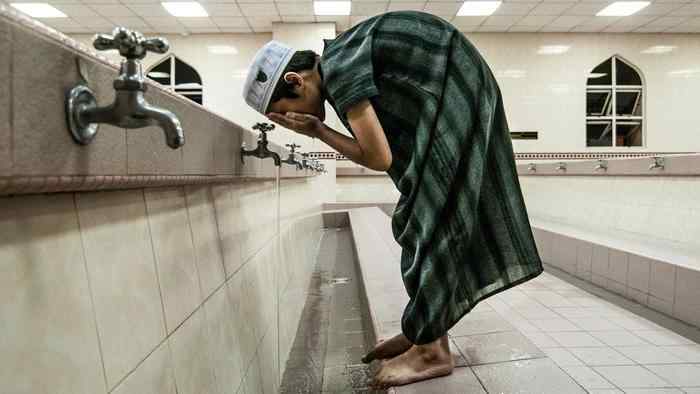
The Sunna is to keep perfume and to use it regularly on oneself. Al-Bukhari narrated that Salman Al-Farsi said: the Prophet ﷺ, said ‘Allah will forgive the sins of the past week for he who on Friday will take a bath, cleanse himself, put on his [regular] perfume or any perfume available in house. Then, he goes out [to Jumu’ah prayer] and does not try to separate two friends. Then he prays wherever he could and listens to the Imam.’ If the body became odorous a day or two before Friday, one should not wait till Friday to cleanse the body. We should wash our bodies as soon as it require washing to keep ourselves clean and fresh. To take a bath on Friday is specifically required since a large number of people will be gathering at mosques. However, if our body became dirty or we sweat on a particular day, 7 then, we should take a bath at the end of day or the next morning. This is indicated by a Hadith narrated by Al-Bukhari and Muslim that Abu Huraira said, the Prophet ﷺ, said: ‘It is the duty of every Muslim to have a bath once every week to wash his head and body.’
From ‘Islamic Manners’ by Shaykh Abdul Fattah Abu Ghuddah”
Islam advocates this etiquette and stresses it so as to perfect the Muslim personality and to bring about harmony among people. There is no doubt that embodying such manners and virtues enhances personal style and qualities, refines personality and brings us closer to the hearts and minds of others. The forthcoming manners and etiquette are central to Islam, its purposes and its aims. Calling it ‘etiquette’ by no means implies that it is marginal to life and social behaviour. It does not mean Muslims have the option of ignoring this code of behaviour, or that it is merely preferable to adhere to it. In pointing out that manners rank higher than deeds, Imam Al-Qarãfi in his book Al-Furwüq said, ‘Learn that a little etiquette is better than a lot of good actions.’ Rwúaim, the righteous scholar, told his son, ‘Oh my son, make your deeds salt, and your manners flour.’ Many good manners with few good deeds are better than many good deeds with few good manners. Even if some of these rules appear to be simple common courtesy, it is important to highlight their significance. Many Muslims commit errors which blemish the Islamic personality, whose purpose is meant to be unique in its beauty, perfection and traits. Our master, the Messenger of Allah ﷺ, directed the blessed companions by saying: ‘You are on your way to meet your brothers, put on a nice dress and fix your riding so you appear distinct among people as a fleck [on a beautiful face]. Allah does not like roughness nor rough manners.’ When the Prophet ﷺ, said: ‘No one will enter Paradise if they have at heart a grain of arrogance.’ A man asked: ‘A man may like his dress to be nice and his shoes nice’ The Prophet ﷺ answered ‘Allah is beautiful and likes beauty. Arrogance is to deny rights and look down at people.’ Shaikh Ibn Taymiyyah said that the beauty that Allah likes includes nice clothes. Hence it could be said that Allah likes all nice things. Therefore, a Muslim ought to be recognized by neat dress, cleanliness and graceful appearance.
From ‘Islamic Manners’ by Shaykh Abdul Fattah Abu Ghuddah
Al-Murshid al-Mu’een – the Concise Guide to the Basics of the Deen – is a widely recognised primary text for learning Islam in North Africa. In it the author, Abd al-Wahid ibn ‘Ashir, summarises in verse the three sciences of Islam, Iman and Ihsan.