Hadith 13 – Love for Your Brother What You Love for Yourself

Hadith 13 – Love for Your Brother What You Love for Yourself
hadith13

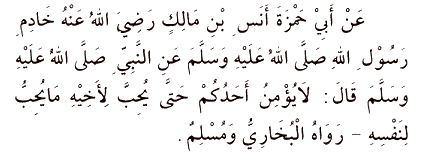
On the authority of Abu Hamzah Anas bin Malik (may Allah be pleased with him) – the servant of the Messenger of Allah (peace and blessings of Allah be upon him) – that the Prophet (peace and blessings of Allah be upon him) said :

“None of you will believe until you love for your brother what you love for yourself.”

Related by Bukhari & Muslim


Click here to listen to the hadith in Arabic:

Al-Murshid al-Mu’een – Lesson 1

Al-Murshid al-Mu’een – Lesson 1

Al-Murshid al-Mu’een

7th June 2017

Lesson 1 of Al-Murshid al-Mu'een

by Shaykh Hamza Yusuf | Al-Murshid al-Mu'een

You can download an audio here – Lesson 1

Al-Murshid al-Mu’een – the Concise Guide to the Basics of the Deen – is a widely recognised primary text for learning Islam in North Africa. In it the author, Sidi Abd al-Wahid ibn ‘Ashir, summarises in verse the three sciences of Islam, Iman and Ihsan. The first section of the poem deals with matters of creed. The second portion covers the pillars of Islam. The last portion deals with the science of spiritual development and behavioral refinement which was traditionally known as Sufism (Tasawwuf).

Sidi Abdul-Wahid b. Ahmad b. ‘Ashir died in the year 1040 AH. His text has been memorized and taught for the past 400 years by Malikis. The text possesses a wealth of knowledge and other benefits that the common Muslim cannot dispense with.

This is a course taught by Shaykh Hamza Yusuf.

Muktasar al-Akhdari – Lesson 1

Muktasar al-Akhdari – Lesson 1

Mukhtasar al-Akhdari

1st June 2017

Lesson 1 of Mukhtasar al-Akhdari

by Shaykh Rami Nsour | Mukhtasar al-Akhdari

You can download the audio here: Lesson 1

You can download a PDF translation here

Mukhtasar Al-Akhdari was written by Abdur Rahman Al-Akhdari a famous Maliki scholar of the 10th century A.H. This text covers purification of the heart, ritual purification and prayer. It also covers an extensive section on “how to correct the prayer” when one makes a mistake which is vital to arriving with certainty towards “perfecting the prayer”.

Mukhtasar Al-Akhdari provides the beginner with the fundamental obligatory knowledge of fiqh along with some very useful principles of fiqh.

This is a course taught by Shaykh Rami Nsour.

The School of Imam Malik

The School of Imam Malik

An Introduction to the School of Imam Malik
Maliki Fiqh
26th MAY, 2017

Imam Malik was born and lived his whole life in Madina and saw the traces of the Companions and Followers and the grave of the Prophet, may Allah bless him and grant him peace, and all the great places there. He felt an enormous esteem for Madina and all it contained which marked his life from his earliest childhood. He maintained this deep-rooted respect until his death and it had a profound impact on his thought, his fiqh and his life in general. He gave great importance to the practice of its people in his ijtihad. Indeed, the principle of the ‘Practice of the People of Madina’ was one of the foundations of his legal method.

Malik grew up in a household which was engaged in the science of Traditions and hadith. His family was interested in the knowledge of the reports and traditions of the Companions and their fatwas. His grandfather, Malik ibn Abi ‘Amir, was one of the great men of knowledge of the Tabi’un. He related from many Companions. It is clear, however, that Anas ibn Malik, Malik’s father, was not greatly concerned with hadith since it is not known that Malik related anything from him, although Malik’s grandfather and uncles were. His family was well-known for their devotion to knowledge. Malik was originally known as ‘the brother of an-Nadr’, a brother of his who was esteemed for his knowledge. Then his own desire to seek knowledge grew to such an extent that people began to say, ‘an-Nadr, the brother of Malik.’
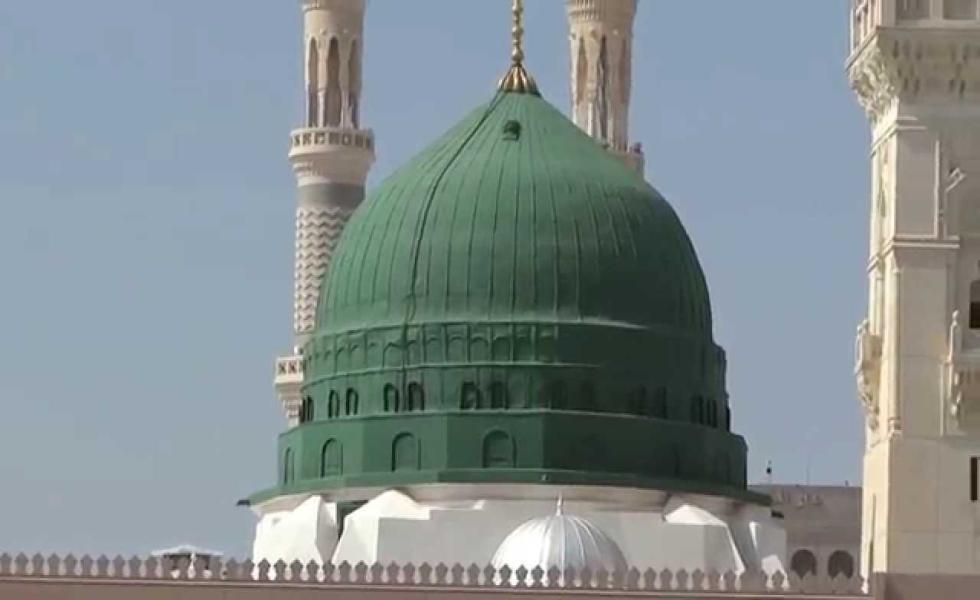
Masjid Nabawi.
Madinah Sharif
After memorising the Qur’an he devoted himself to memorising hadith, which was much encouraged in the environment of Madina. Malik went to the assemblies of scholars to write down what they taught and study it. Malik devoted himself to knowledge from an early age and sought it out from the people of knowledge in Madina. He confined himself to two areas of knowledge: hadith and fiqh. He did not like to argue about the reports of the various sects regarding matters about which people become confused and disagree. That was not due to any ignorance of their positions but was based on knowledge and clear evidence because he saw that delving into such things had no benefit.

“I love to honor the Hadith of the Messenger of Allah (S), and I do not read Hadith without wudu”.

—Imām Mālik [d. 179H/795CE]

He learned the fatwas of the Companions from the Tabi’un and the Tabi’i’t-Tabi’in. He learned ‘Umar’s fatwas and those of Ibn Umar, ‘A’isha and other Companions. He learned the fatwas of Ibn al-Musayyab and other great Tabi’un. Their fatwas are the source of much of Maliki fiqh.

Masjid Nabawi.
Madinah Sharif

Malik lived surrounded by the traces of the Tabi’un and Companions, and he learned the fatwas of the Companions from the Tabi’un and singled out those whose opinions were best. He investigated the reports of ‘Umar and Ibn Mas’ud and other fuqaha’ of the Companions, studying their cases and rulings.

In the above video, Shaykh Ali Laraki gives an introduction to the school (madhab) of Imam Malik and the school of Madinah
40 HADITH
The 40 Hadith, compiled by Imam Nawawi
JUZ ‘AMMA

A resource to help you memorise Juz ‘Amma

TAJWEED
Learn Tajweed with Shaykh Yasir Qadhi

Pin It on Pinterest