Lesson 2 of Matn al-‘Ashmawiyyah – Purification and Things Which Nullify Wudu

Lesson 2 of Matn al-‘Ashmawiyyah – Purification and Things Which Nullify Wudu
Matn al-‘Ashmawiyyah

19th June, 2017

Nawaaqid ul-wudu1

(Things Which Nullify Wudu)

This is a course taught by Ustadh Abdus Shakur Brooks covering the entire text. This text covers the essentials of purification, prayer and fasting according to the Mālikī school.

Matn

al-‘Ashmawiyyah.

Purification – Things That Nullify Wudu

You can download an MP3 of this lesson here: Lesson 2 – Purification and Things Which Nullify Wudu

You can download a PDF of the english text here: Matn al-Ashmawiyyah


Lesson Notes:

Know, and may Allah grant you success, that things which nullify wudu are of two types:

1. Ahdaath2 (Impurities)
2. Asbaab ahdaath3 (Things which lead or may cause impurities).

Ahdaath (Impurities) are five:

Three of them are from the front (genitals):

1. Madhyu (Prostatic fluid)4
2. Wadyu (Genital discharge)5
3. Bawl (Urine)

And two of them are from the behind:

1. Ghaa’it (excrement)
2. Riyh (passing wind)

Asbaab ahdaath (those things which may cause or lead to impurities):

1. Sleep is of four types.

 Long and heavy sleep nullifies wudu,
 Short and heavy sleep also nullifies wudu,
 Short and light sleep does not nullify wudu
 Long and light sleep, it is merely recommended to refresh wudu.

2. Fainting.
3. Vanishing of intellect due to insanity.
4. Drunkenness.
5. Apostasy.
6. Doubt, whether or not one has wudu.
7. Touching the penis with the palm of the hand, the insides or the sides of the fingers, even if by one finger6.

As for touching (the opposite sex)7 it is of four types:

1. If pleasure is intended and thus found, wudu is nullified
2. If pleasure is found but was not intended, wudu is nullified,
3. If pleasure is intended but not found, wudu is nullified
4. If pleasure is not intended and indeed not found, in this case, wudu is not nullified.

It does not nullify wudu:

1. To touch the (your) buttocks
2. To touch the (your) testicles
3. To touch the genitals of little kids when cleaning/changing them.
4. To vomit
5. To eat camel meat
6. Cupping and bleeding (as a therapeutic measure)
7. To laugh in salaah.
8. For a woman to touch her private part but it is said if she fondles she needs to make wudu.

And Allah knows best.

Footnotes:

1 Wudu is one of the conditions for prayer; there is no prayer without wudu (under normal circumstances). This is the ritual washing of specific limbs as commanded by Allah in Surah Ma’idah:6

“Oh you, who have believed, when you rise to [perform] prayer, wash your faces and your forearmsto the elbows and wipe over your heads and (wash) your feet to the ankles…”

2 Ahdaath (plural for hadath) are things which are absolutely impure in themselves. They immediately nullify wudu of a person from whom they emanate.
3 Asbaab ahdaath are not impurities in themselves but things which may cause or may lead to impurity.
4 Prostatic fluid is that liquid which appears when a person is aroused due to intimacy between the spouses or thoughts.
5 Wadyu (genital discharge) is a thick and whitish fluid which appears after urine.
6 This applies to a person touching his own penis, not a penis of someone else, as in a case of the doctor and also this refers to direct skin to skin contact. There is no harm if there is a veil or towel in between.
7 The opposite sex intended here, is one from whom pleasure (sexual arousal) can be derived as in a case between wife and husband or anyone whom Islam permits one to marry.
40 HADITH

The 40 Hadith, compiled by Imam Nawawi

JUZ ‘AMMA

A resource to help you memorise Juz ‘Amma

TAJWEED

Learn Tajweed with Shaykh Yasir Qadhi

Lesson 1 of Matn al-‘Ashmawiyyah – The Introduction

Lesson 1 of Matn al-‘Ashmawiyyah – The Introduction

Matn al-‘Ashmawiyyah

17th June, 2017

The work, Matn al-‘Ashmawiyyah, by the great scholar ‘Abd al-Baari al-‘Ashmaawiy ar-Rifaa’iyyu, is one of the most celebrated introductory texts in the Malik Madhhab. Traditionally, it was either this text or Matn al-Akhdari which were used as primers for beginners in the Maliki Madhhab, depending on where one was situated on the map. This text, Matn al-‘Ashmawiyyah, was more ideal in East Africa and the latter was more favored in the West, up to North Africa. This treatise explores aspects of worship by which a beginner absorbs enough to make his servitude to Allah correct.

This is a course taught by Ustadh Abdus Shakur Brooks covering the entire text. This text covers the essentials of purification, prayer and fasting according to the Mālikī school.

Matn

al-‘Ashmawiyyah.

Introduction

You can download an MP3 of this lesson here: Introduction

You can download a PDF of the english text here: Matn al-Ashmawiyyah

40 HADITH
The 40 Hadith, compiled by Imam Nawawi
JUZ ‘AMMA

A resource to help you memorise Juz ‘Amma

TAJWEED
Learn Tajweed with Shaykh Yasir Qadhi

Hadith 14 – Prohibition of Blood of a Muslim

Hadith 14 – Prohibition of Blood of a Muslim

16

JUNE, 2017

40 Hadith of Imam Nawawi

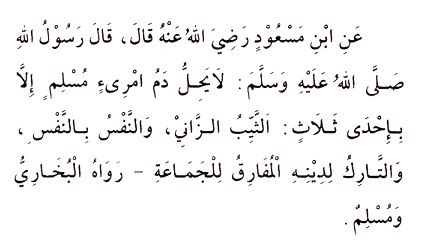
On the authority of Abdullah Ibn Masud (may Allah be pleased with him) who said: The Messenger of Allah (peace be upon him) said:

Hadith 14 – Prohibition of Blood of a Muslim

Hadith 14 - Prohibition of Blood of a Muslim

by Imam Nawawi | 40 Hadith

It is not permissible to spill the blood of a Muslim except in three [instances]: the married person who commits adultery, a life for a life, and the one who forsakes his religion and separates from the community.

Bukhari and Muslim

Ruling Only For Government

Someone’s blood and life is a very big issue. It is not something that you can take into your own hands; it’s not something to be decided by mere opinion. It is something that must be established and known through textual sources. The text has to be there and it is what clarifies whether or not there is any opening or discussion to these issues. In addition, they are issues of capital punishment and governance. They are not issues of personal vendettas or grudges carried out by individuals. They have to be carried out by governmental bodies.

The Prophet (pbuh) had many roles in the society, and amongst those roles he ran a state, he was a judge, and he gave opinions to people according to the religion. If it was something he did as a ruler or a judge, then we have to leave it that way, and it should not be something that applies to everyone else’s personal behavior. The topic of this hadith is a topic of governance and so it does not really apply to Muslims in the West.

How It’s Established

For the one that commits adultery, committing sexual acts outside the contract of marriage, the conditions for establishing such an act in front the court, and thereby requiring punishment, are very strict. There must be four male witnesses that witnessed the actual act itself, and they all have to come to court at the same time. If someone comes and makes this claim without having these four witnesses, then they will actually be punished for slandering the people that were accused. It’s severe because if someone is making an accusation like this, they have to make sure they have all of their evidences, otherwise the accuser themselves get punished, and this is done publicly. The other possibility is if someone confesses. Although this seems implausible, some scholars researched the court rulings that were carried out in the Ottoman Empire. They were shocked that there were people who committed adultery and then went to the court and confessed it.

As for the life for a life, there must be two reliable witnesses and it must be established by the court.

As for deciding that someone has left Islam, it is not something that is carried out by every individual. We can’t say someone said or did such-and-such, and because of it they are no longer Muslim so we have to kill them or take away their property. This is nonsense. It needs to be established by some sort of body that is official.

If the ruling is being applied, it is by a governmental body. However, the decision of whether or not a person is considered to be outside the fold of Islam needs to be done by scholars. These scholars would need to sit down with the person, ask particular questions, see what’s going on with them, and address any issues that can possibly be addressed. Once that has all taken place and there is still no reconciliation, then at that point, that particular individual can be labeled as a “kafir”, as someone who has left the religion of Islam. Again, this is not something that can be done by regular people. To go around calling someone else a kafir is absolute nonsense. Such behavior should not be accepted and steps should be taken to convince the individual of a different approach so as to limit the harm that comes from such declarations.

The Actual Punishment

The majority of scholars throughout history have said that the punishment for someone who commits adultery is death, but there is a very minority opinion that says their punishment is to be lashed, and that the government then has the option of capital punishment on top of the lashing.

There has been disagreement historically about the punishment of a life for a life. What if a slave kills a free person, what if a non-Muslim kills a Muslim, or vice versa in either case? The opinion that I believe is stronger, which I rarely say, is what is more applicable to our modern society, is that everyone is the same. Anyone that takes someone else’s life away, regardless of their social, religious, political status is eligible to receive the capital punishment. This punishment and whether it is to be carried out is in the hands of the family of the victim, whether they agree to the capital punishment or choose to forgive the offender.

The third case is where the person leaves Islam and the community. This ruling requires an entire political and religious system based on Islam. Not only do they leave their religion, but they are calling against the religion and fighting against the community. Some scholars say regardless of whether they turn against the community or not, once they leave the religion, they should receive capital punishment. Other scholars in history and modern time say it’s not applicable to someone that only leaves Islam but if they leave Islam and commit treason then they are eligible for the death penalty.

At the end of the day, these are all possibilities and the government chooses what laws it implements. Just because it’s a possibility, doesn’t mean it will be chosen. So governance and political theory get very complicated.

Overall, someone else’s life and blood are very important and cannot be touched without textual support and government-based action. On top of that there are also strict ways to establish guilt in these cases. When it comes to confessing, some scholars say it’s actually better not to confess and to keep one’s sins secret. Rather, they should make sincere repentance to Allah and move on.

May Allah (swt) give us an understanding and forgive us for our sins and shortcomings.

From 40HadithNawawi.com A Project of Muslim American Society

More Posts

Al-Murshid al-Mu’een – Lesson 4

Al-Murshid al-Mu'een 7th June 2017 You can download an audio here - Lesson 4 Al-Murshid al-Mu’een – the Concise Guide to the Basics of the Deen – is a widely recognised primary text for learning Islam in North Africa. In it the author, Sidi Abd al-Wahid ibn ‘Ashir,...

Lesson 5 of Matn al-‘Ashmawiyyah – Obligatory, Sunnah and Virtuous Acts of Ghusl

Matn al-'Ashmawiyyah 27th June, 2017 Ghusl This is a course taught by Ustadh Abdus Shakur Brooks covering the entire text. This text covers the essentials of purification, prayer and fasting according to the Mālikī school. Matn al-'Ashmawiyyah. Purification -...

Lesson 4 of Matn al-‘Ashmawiyyah – Obligatory, Sunnah and Virtuous Acts of Wudhu

Matn al-'Ashmawiyyah 23rd June, 2017 Wudhu This is a course taught by Ustadh Abdus Shakur Brooks covering the entire text. This text covers the essentials of purification, prayer and fasting according to the Mālikī school. Matn al-'Ashmawiyyah. Purification -...

Mukhtasar al-Akhdari – Lesson 4

Mukhtasar al-Akhdari 22nd June 2017 You can download the audio here: Lesson 4 You can download a PDF translation here Mukhtasar Al-Akhdari was written by Abdur Rahman Al-Akhdari a famous Maliki scholar of the 10th century A.H. This text covers purification of the...

Al-Murshid al-Mu’een – Lesson 3

Al-Murshid al-Mu'een 7th June 2017 You can download an audio here - Lesson 3 Al-Murshid al-Mu’een – the Concise Guide to the Basics of the Deen – is a widely recognised primary text for learning Islam in North Africa. In it the author, Sidi Abd al-Wahid ibn ‘Ashir,...

Al-Murshid al-Mu’een – Lesson 2

Al-Murshid al-Mu’een – Lesson 2

Al-Murshid al-Mu’een

7th June 2017

Lesson 2 of Al-Murshid al-Mu'een

by Shaykh Hamza Yusuf | Al-Murshid al-Mu'een

You can download an audio here – Lesson 2

Al-Murshid al-Mu’een – the Concise Guide to the Basics of the Deen – is a widely recognised primary text for learning Islam in North Africa. In it the author, Sidi Abd al-Wahid ibn ‘Ashir, summarises in verse the three sciences of Islam, Iman and Ihsan. The first section of the poem deals with matters of creed. The second portion covers the pillars of Islam. The last portion deals with the science of spiritual development and behavioral refinement which was traditionally known as Sufism (Tasawwuf).

Sidi Abdul-Wahid b. Ahmad b. ‘Ashir died in the year 1040 AH. His text has been memorized and taught for the past 400 years by Malikis. The text possesses a wealth of knowledge and other benefits that the common Muslim cannot dispense with.

This is a course taught by Shaykh Hamza Yusuf.

Mukhtasar al-Akhdari – Lesson 2

Mukhtasar al-Akhdari – Lesson 2

Mukhtasar al-Akhdari

8th June 2017

Lesson 2 of Mukhtasar al-Akhdari

by Shaykh Rami Nsour | Mukhtasar al-Akhdari

You can download the audio here: Lesson 2

You can download a PDF translation here

Mukhtasar Al-Akhdari was written by Abdur Rahman Al-Akhdari a famous Maliki scholar of the 10th century A.H. This text covers purification of the heart, ritual purification and prayer. It also covers an extensive section on “how to correct the prayer” when one makes a mistake which is vital to arriving with certainty towards “perfecting the prayer”.

Mukhtasar Al-Akhdari provides the beginner with the fundamental obligatory knowledge of fiqh along with some very useful principles of fiqh.

This is a course taught by Shaykh Rami Nsour.

Mukhtasar Al-Akhdari was written by Abdur Rahman Al-Akhdari a famous Maliki scholar of the 10th century A.H. This text covers purification of the heart, ritual purification and prayer. It also covers an extensive section on “how to correct the prayer” when one makes a mistake which is vital to arriving with certainty towards “perfecting the prayer”.

Mukhtasar Al-Akhdari provides the beginner with the fundamental obligatory knowledge of fiqh along with some very useful principles of fiqh.

This is a course taught by Shaykh Rami Nsour.

Pin It on Pinterest