as-Safat ul-Keram – Tajweed Lesson 2
Learn Tajweed – Lesson 2
A series of videos from Shaykh Yasir Qadhi entitled as-Safat ul-Keram (The Noble Emissaries).

Learn Tajweed – Lesson 2

Learn Tajweed – Lesson 1
5
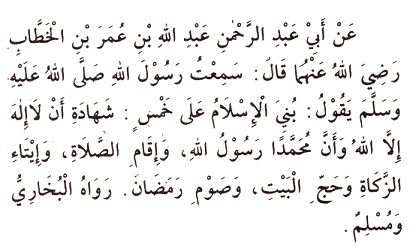
It is narrated on the authority of Amir al-Mu’minin (Leader of the Believers), Abu Hafs ‘Umar bin al-Khattab (may Allah be pleased with him), who said: I heard the Messenger of Allah (peace be upon him), say:
Hadith 3 – Islam is Built Upon Five
Islam has been built on five [pillars]: testifying that there is no God but Allah and that Muhammad is the Messenger of Allah, performing the prayers, paying the Zakah, making the pilgrimage to the House, and fasting in Ramadan.
Bukhari & Muslim
This hadith focuses on the five pillars of Islam. The Prophet (sas) describes the foundations of Islam as having been “built upon five.” These foundational actions are either of the tongue, heart or otherwise.
Imagine a home above the ocean, with five pillars that reach to the ground to support the home above. That is the imagery that comes to mind when the Prophet (sas) talks about these five aspects upon which Islam is built.
The Shahadah is a beautiful, profound, yet simple statement which brings one into Islam. All the person has to say is: “La ilaha illa Allah, Muhammad rasulAllah.” “I bear witness that there is no deity worthy of worship but God, and I bear witness that Muhammad is the Messenger of God.”
These few words in themselves are very powerful and sometimes we don’t realize that. We think about all the details in Islam, all of the sayings of the Prophet (pbuh), and many times we forget the Quran. Sometimes we become concerned about legal rulings and we forget that “La ilaha illa Allah Muhammad rasul Allah” is really the foundation of everything. It is an absolute commitment to worship nothing other than Allah and to put all of one’s reliance on Allah, and to follow the Prophet (pbuh) as His Messenger, who was sent to mankind to embody the divine message just as other Prophets before Him.
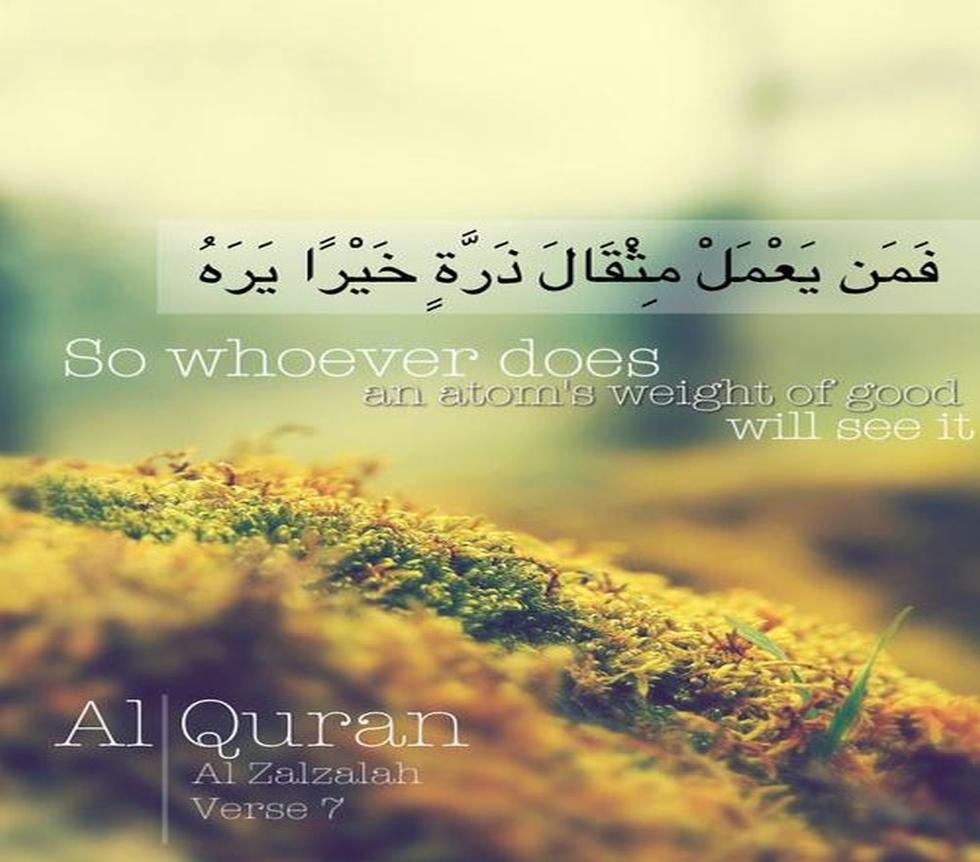
The second pillar of Islam, after the declaration of faith, is the establishment of prayer. It is very interesting terminology that is used in “the establishment of prayer.” The verb used in Arabic implies effort. The verb is “to establish,” as if one is making something stand. Essentially you are making something stand, so you are making your prayer stand, you are making the prayer happen; you are pushing it to a curve, you are sticking with it, and you are leaning upon it. It is also a foundation for your relationship with Allah.
It is important that we make the effort and we put forth the proper means in order to pray our prayers on time. One of the easiest effort is to make the intention to always make the prayers at the beginning of their time.
The third pillar of Islam is foundational. Allah (swt) describes the believers in Surah Al-Mu’minun as those who observe and establish the institution of Zakaah in society:
“And they who are observant of Zakah.” (The Quran 23:4)
Allah has made it obligatory on the Muslims to pay a certain percentage , 2.5%, in Zakaah when their wealth exceeds a minimum amount and a year has passed since that amount has been accumulated. It could be gold, silver, or any sort of wealth.
Hajj is to make pilgrimage to the house of Allah, the Kabah, in Mecca to perform the traditional rights that were performed by the Prophet (sas). Hajj is one of the most beautiful human experiences and one of the greatest migrations on earth. It is absolutely incredible to experience the unity of millions of Muslims making pilgrimage to the Kaaba from every corner of the world.
“Oh you who believe, fasting is prescribed upon you, as it was prescribed to those before you, that you may attain God-consciousness (taqwa)” (The Quran 2:183)
5
40 Hadith of Imam Nawawi
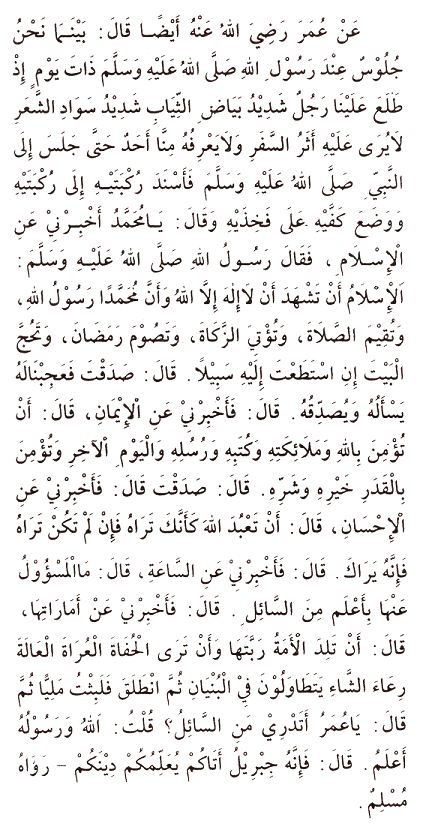
It is narrated that ‘Umar also said:
Hadith 2 – Islam, Iman, Ihsan
While we were one day sitting with the Messenger of Allah (peace be upon him), there appeared before us a man dressed in extremely white clothes and with very black hair. No traces of journeying were visible on him, and none of us knew him. He sat down close by the Prophet (peace be upon him), rested his knee against his thighs, and said, “O Muhammad! Inform me about Islam.”
The Messenger of Allah (peace be upon him) said, “Islam is that you should testify that there is no deity except Allah and that Muhammad is His Messenger, that you should perform salah, pay the Zakah, fast during Ramadan, and perform Hajj to the House, if you are able to do so.”
The man said, “You have spoken truly.” We were astonished at his questioning him (the Messenger) and telling him that he was right, but he went on to say, “Inform me about iman.”
He (the Messenger of Allah) answered, “It is that you believe in Allah and His angels and His Books and His Messengers and in the Last Day, and in qadar (fate), both in its good and in its evil aspects.” He said, “You have spoken truly.”
Then he (the man) said, “Inform me about Ihsan.” He (the Messenger of Allah) answered, “It is that you should serve Allah as though you could see Him, for though you cannot see Him yet (know that) He sees you.”
He said, “Inform me about the Hour.” He (the Messenger of Allah) said, “About that, the one questioned knows no more than the questioner.” So he said, “Well, inform me about the signs thereof.” He said, “They are that the slave-girl will give birth to her mistress, that you will see the barefooted, naked, destitute, the herdsmen of the sheep (competing with each other) in raising lofty buildings.” Thereupon the man went of. I waited a while, and then he (the Messenger of Allah) said, “O Umar, do you know who that questioner was?” I replied, “Allah and His Messenger know better.” He said, “That was Jibril (the Angel Gabriel). He came to teach you your religion.
Muslim
This hadith includes within it all outwardly actions and inwardly beliefs. The sciences of the Sharia’ return back to this hadith due to it encompassing knowledge of the Sunnah. Hence, some of the scholars have termed this hadith the Mother or Core of the Sunnah, just as Surah al-Fatiha has been termed the Mother or Core of the Qur’aan, due to it containing the entire Message of the Qur’an.
This hadith is also known as Hadith Jibreel (Angel Gabriel) (as). The hadith tells the story of Jibreel (as) when he came to the Prophet (sas), asking a set of questions. The Prophet (sas) responded to those questions and then addressed his companions. There is a door called “Baab Jibreel” at Masjid An-Nabawi in Madina. It is known as the door that Jibreel (as) came in to ask the Prophet (sas) these questions.

It is very important for du’aat (Islamic workers ) to be aware of their surroundings, and to recognize what’s going on around them so they can act appropriately. Umar (ra) noticed that a well-kept individual with clean clothes, whom he didn’t know, entered the Masjid with no trace of travel on him. Umar (ra) was conscious; he could sense that this man was not an ordinary man, nor a man from “around town.”
The da’wah, the call to Islam, is very much predicated upon the building of relationships with people. The people who care about inviting others to Islam and spreading the deen of Allah (swt), should notice what’s going on around them. They should notice when someone new comes into the masjid. They should notice if someone is left out or if someone is sitting by him or herself. Then they can proceed from there in terms of figuring out how to deal with that situation. The call towards the deen of Allah is predicated upon brotherhood, sisterhood, love for the sake of Allah; and that requires paying attention to the situations of people around us.
Jibreel (as) came dressed in a very nice and clean way. He sat in front of the Prophet (pbuh) in a very respectful and humble way. There are many things that the scholars took from this Hadith in terms of seeking knowledge. Among the etiquettes of seeking knowledge is students should have decent apparel, they should look clean as much as possible. Moreover, they should show a high level of respect towards their teachers.
Jibreel (as) turns to the Prophet (sas) and says, “Tell me about Islam”. The Prophet’s answer was centered around outward actions. Then he asks him about iman and the Prophet’s answer focused on internal actions of belief and of thought.
Islam and iman are interchangeable concepts revolved around the five pillars of action and the six foundations of belief. When Islam and iman are mentioned together in the same place, then Islam refers to the outward actions and iman refers to the inward beliefs.
Belief manifests itself. The scholars say that a belief lives in the heart and shows itself on the actions and on the tongue. For example, the Prophet (sas) said that the Muslim is the person who the people are safe from his hands and his tongue. And the believer is the one who people trust him with their wealth and themselves.
Scholars consider Islam, Iman and Ihsan the three stages in the path towards Allah (swt). The first path is you force yourself and bring yourself to do those actions which you know that Allah wants you to do. The second level is iman where you are not only doing those actions, but you are strengthening your relationship with Allah (swt) and you’re beginning to taste the sweetness of your relationship with Allah. The third level is the level of Ihsan, which is to worship Allah as if you see Him, and even if you cannot see Him, to know that He sees you. So, you are moving in this path, this journey, towards the Divine. And in doing so, it’s getting more and more intense.
When Jibreel asked the Prophet (sas) about the hour, He said, “The one who is being asked about it is not more knowledgeable about it than the one who is asking.” Here, the Prophet (sas) is saying, this is something that Allah (swt) keeps to Himself and it is part of the “ghayb” (unseen). This is an important lesson because it doesn’t matter when the Day of Judgment is, what really matters is what and how we are preparing for it. We should be continuously striving to please Allah and seek his forgiveness.
The next question was, “So, tell me about it’s signs, tell me about the things that will occur”. These signs are considered as warnings. The Prophet (sas) gave two signs to this particular hadith of the end of time. One of them is, “the slave woman will give birth to her master,” and the tense is feminine so it is referring to her female master.
One of the interpretations that relates to modern time would be: The one who gives birth is supposed to be in power, or have some sort of level or authority over the one who she gives birth to. But this here is a flipping of the scale. The one who gives birth becomes the servant of the one who is born. Whereas before, the child would respect, honor and listen to their parents. Now it’s the complete opposite, and if you look around, you will see it. You see and feel as if the parents are slaves to the children. Parents desperately trying to please their children, and moms are trying to imitate their daughters.
The second sign; is the person will see barefooted, lightly dressed, and poor people who are shepherds. They will see these people competing with one another in their buildings. The point here is you have these people who don’t have anything, they are very poor. Then suddenly the situation changes for them, and they are competing with one another over who can build the tallest building. They are competing to see who has the nicest car, the latest gadgets, etc.
In the end, all of this is from the blessings of Allah (swt). Allah (swt) gives us so much and rather than being humble and grateful in front of Allah, we are arrogant and think that it is all from us. Righteousness, putting full effort and trying one’s best will all eventually lead to success and wealth. But at the end of the day, we still have to acknowledge that no matter how much effort we put in, our wealth and success will always be in the hands and bounty of Allah. So, being successful and having wealth should give us more reasons to increase our humility and increase our gratitude towards our Lord.
From 40HadithNawawi.com A Project of Muslim American Society
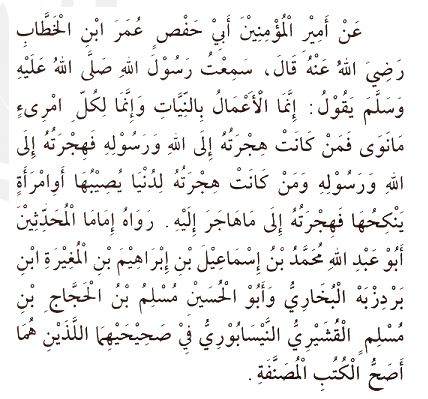
Actions are according to intentions, and everyone will get what was intended. Whoever migrates with an intention for Allah and His messenger, the migration will be for the sake of Allah and his Messenger. And whoever migrates for worldly gain or to marry a woman, then his migration will be for the sake of whatever he migrated for.
Bukhari and Muslim
This hadith is central to Islamic thought, culture, and undertanding and shows the balance between the internal and external states of oneself. This hadith is great in its benefit and importance, and it has been said that Islam revolves around it. Scholars have commented that this hadith comprises one-third of knowledge because the actions of man involve his heart, his tongue and his limbs, and hence the intention in the heart is one-third of action. It is also deemed to be one-third of knowledge due to scholars commenting that this hadith along with two others comprises the religion of Islam. The other two hadith being “The Halal is clear and the Haram is clear and between them are doubtful matters”(1), and “Whoever innovates in this religion that which is not from it will have all his actions rejected (by Allah).”(2)
The believers should be visionaries because they should always be checking their intentions and understanding the purpose of their actions. They should be persistently asking themselves about their intentions for their short term and their long goals. Overall, the believer should constantly ask himself; “Why am I doing what I am doing?”
Using the words “shall have” in this hadith means that the person will be rewarded for only that which he intended. So, as mentioned in the hadith, if a person performed the Hijrah, but did it with a different intention then he would not be rewarded for that action of Hijrah.
Riya?, the showing off of deeds publicly, is a major sin which ruins sincerity and can invalidate actions. In the wording of the hadith, the use of the word “by” in “actions are but by intention” refers to the fact that the acceptance and correctness of any action depends on the intention behind it. For example, giving money in charity will not be accepted as a good deed if it was for the sake of showing off to others.
The Prophet (sas) informed us that if you perform an act for the sake of someone else rather than for Allah’s sake, then Allah will reject that deed entirely and will leave the reward of it for the partner that the person has made. This highlights the implications of showing off as well as the graveness of associating another person in your actions which should have been for the sake of Allah (swt). As mentioned in the hadith, ‘Thus he whose migration was for Allah and His messenger, his migration was for Allah and His messenger, and he whose migration was to achieve some worldly benefit or to take some woman in marriage, his migration was for that for which he migrated.”
Everything we do has to be intended for the sake of Allah (swt). A good action with the wrong intention will not get us any reward in the Hereafter.
[1] Hadith 5: Rejection of Evil Deeds and Innovations
[2] Hadith 6: The Halal is Clear and the Haram is Clear